
The Grudge — Episode 12: Natural Selection; The Man History Forgot
The Grudge — The Rivalry Between Alfred Russel Wallace vs. Charles Darwin
A fever breaks on an island thousands of miles from London. In its aftermath, Alfred Russel Wallace puts into words an idea that has been gathering in the wild: species do not simply endure; they are shaped, altered, and separated by the brutal arithmetic of survival. He sends the essay to Charles Darwin, not knowing that the man receiving it has spent twenty years guarding a similar revelation—one that could either transform his life’s work or force him to share the future with a stranger.
No shouting match follows. No courtroom decides the matter. Instead, the collision unfolds through letters, influence, private manuscripts, and the careful intervention of men positioned close to scientific power. Wallace’s essay and Darwin’s earlier writings are presented together at the Linnean Society in 1858, creating a public record of shared discovery. But shared credit is not the same as equal memory. When On the Origin of Species arrives the next year, Darwin’s name takes hold of the theory, while Wallace becomes the brilliant figure at the edge of the frame—the co-discoverer acknowledged in footnotes but rarely carried into legend.
This is not a simple tale of theft, nor an easy story of villains and victims. It is the story of a message sent from the margins into the center of power—and of what happens when two men arrive at the same truth, but only one possesses the networks, standing, and moment required to make that truth his own.
Alfred Russel Wallace January 8, 1823 – November 7, 1913
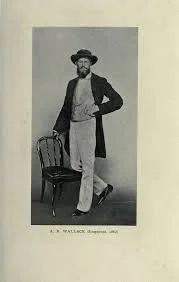
Alfred Russel Wallace was born in Usk, Monmouthshire, Wales, into a family without the wealth, institutional access, or inherited standing enjoyed by many Victorian scientists. He educated himself through work, reading, collecting, surveying, and travel, then built his reputation not from a university laboratory but through years spent observing the natural world in some of its most remote and demanding places.
Wallace’s early collecting expedition to the Amazon, followed by eight years in the Malay Archipelago, placed him among an extraordinary range of species, landscapes, and peoples. In 1858, while on the island of Ternate, an episode of fever helped precipitate a breakthrough: he drafted an essay explaining how environmental pressures could favor some variations over others. He sent the manuscript to Darwin, whom he respected, asking him to pass it to Charles Lyell if Darwin thought it worthwhile. That letter triggered the joint Linnean Society presentation and forced Darwin’s long-held work into public view.
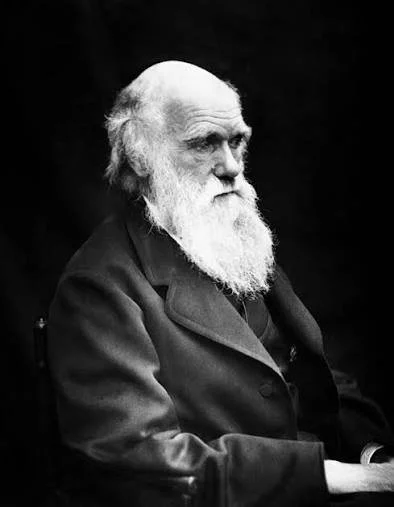
Charles Darwin
February 12, 1809 – April 19, 1882
Charles Robert Darwin was born in Shrewsbury, England, into a prosperous and well-connected family. His route toward evolutionary theory began with a five-year voyage aboard HMS Beagle, from 1831 to 1836, where close observation of fossils, geological change, and the variation of species gave him evidence that life was not fixed. Back in England, Darwin spent decades testing, refining, and quietly protecting his developing explanation for how species changed.
By the time Wallace’s essay reached him in June 1858, Darwin had already written extensive private work on natural selection. The arrival of Wallace’s independently conceived argument created an urgent problem of scientific priority. With the involvement of Lyell and botanist Joseph Dalton Hooker, extracts of Darwin’s earlier writings and Wallace’s essay were presented together, establishing the theory publicly under both names.