
The Soldier’s Silence: A Voice Lost in Military History
Episode 20: The Soldier’s Silence — Cathay Williams
Long before the uniform was fastened at dawn, before the cadence of drills or the weight of a rifle settled into muscle and bone, we enter the disciplined resolve of a soldier who carved survival from a world determined not to see them. What follows is not a simple chronology, but a restoration — a constellation of marches, postings, and deliberate acts of endurance that together reveal a presence that carried duty across the frontier, defied exclusion, and redefined a military institution that offered little space for such courage.
As you move through this story, you’ll encounter the campaigns endured against expectation, the choices rendered with unwavering intention, and the unmistakable imprint of a life that refused erasure. Each surviving record stands as evidence of a mastery they were never expected to claim, a determination to translate constraint into resilience, and a steady resolve to let their service stand even when recognition rarely followed their name.
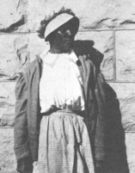
This image is one of the few surviving visual traces associated with Cathay Williams, and even here the record is uncertain. Blurred, partial, and stripped of context, it reflects the larger truth of her life — a story lived in full, yet documented in fragments. What remains is not clarity, but evidence: a reminder of how thoroughly her presence was overlooked, and how much of her history must be restored from what the archive failed to keep.
By Unknown author -
Cathay Williams — Condensed Life Timeline
1844 — Born in Independence, Missouri, into slavery.
1861–1865 — Forced into Union Army service as “contraband” during the Civil War.
1866 — Enlists in the U.S. Army as “William Cathay,” becoming the first documented Black woman to serve.
1866–1868 — Serves with the 38th U.S. Infantry (Buffalo Soldiers) in New Mexico Territory.
1868 — Discharged after her identity is discovered.
1870s — Works as a cook, seamstress, and laundress in Colorado.
1876 — Her story becomes public through a St. Louis reporter.
1891 — Applies for a military pension; denied.
1890s — Health declines; final years undocumented.
Date of death unknown.
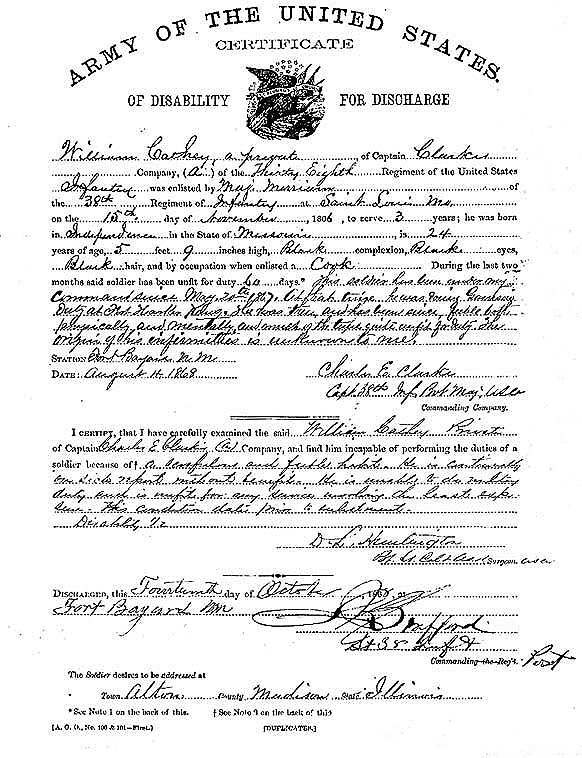
This final document stands as a reminder of how much the archive chooses to preserve — and how much it allows to disappear. Here, the military recorded every measurable detail of a soldier’s body, service, and wounds, yet left entire lives undocumented, unnamed, or unacknowledged. For every record that survived, countless others were never written, never kept, or never attributed to the people who earned them.
Placing this artifact at the end of the section is intentional. It is a testament to the unevenness of historical memory — the way some stories are captured in precise handwriting while others, like Cathay Williams’, survive only in fragments, contradictions, and blurred traces. The document becomes a mirror: evidence of what was valued, and evidence of who was not.