
Forgotten Filament: The Innovator behind the Glow
Episode 10: Forgotten Filament— Howard Lewis Latimer
This episode unfolds as a monologue of vision and restraint — the tension between a mind lit with possibility and a world that rarely paused long enough to see it. For Lattimer, innovation became both revelation and resistance: a design pressed against the limits of recognition, a spark refusing to fade.
Across these images and artifacts, his presence gathers form — not loudly, but unmistakably. Drafts sketched in quiet corners, ideas carried without applause, and contributions that slipped through history without the name they deserved. What once lived in the periphery begins to glow at the center.
This opening invites you into an unveiling — where a brilliance long overshadowed steps forward, and the legacy of crafting light in silence finally claims its place. Move ahead and witness the journey that endured, even when the world tried to look past it.
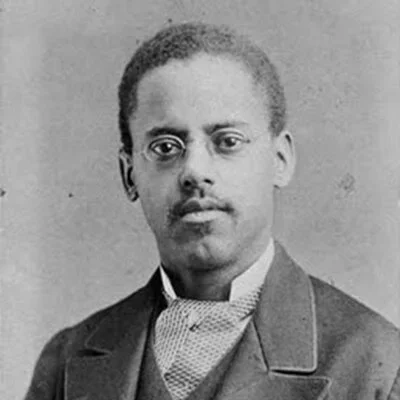
This image captures more than a man — it holds the quiet force of innovation that reshaped the world from its margins. Lewis Howard Latimer, born to formerly enslaved parents, drafted the blueprints that powered Edison’s vision and patented the carbon filament that made electric light practical. Yet history rarely spoke his name.
In this portrait, we see the clarity of purpose behind the round glasses, the resolve in the set of his jaw, and the brilliance that refused to be dimmed. Latimer’s contributions were not loud, but they were lasting — pressed into patents, etched into engineering, and carried forward in every room lit by his legacy.
This is the face of a man who composed in silence — and whose light still burns.
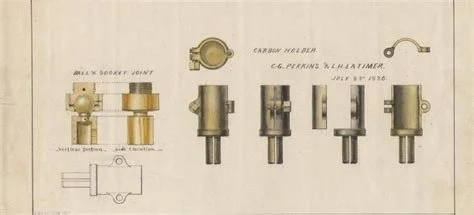
This drawing is more than ink on paper — it’s a blueprint of brilliance pressed into history by a hand the world tried to overlook. In 1881, Lewis Howard Latimer patented a method for producing carbon filaments, a breakthrough that made electric lighting practical, durable, and accessible.
His sketches, precise and quietly revolutionary, mapped the future of illumination. They bridged invention and invisibility — technical mastery rendered in lines that carried no fame, only function. Yet without them, the glow we take for granted might never have reached our homes.
This is the mark of a mind that composed in silence. A filament born from vision, restraint, and the refusal to disappear.
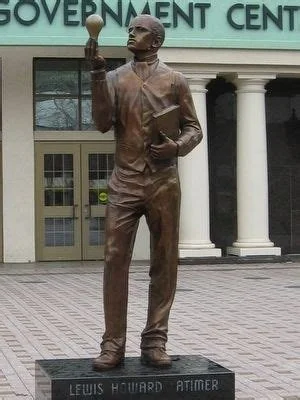
Lewis Howard Latimer (1848–1928)
Inventor • Engineer • Draftsman • Pioneer of Electric Light
Lewis Howard Latimer was one of the most influential yet overlooked figures of the electrical age. Born in Chelsea, Massachusetts to parents who had escaped enslavement, Latimer rose from modest beginnings to become a leading engineer in America’s early electrical industry.
Latimer worked with three of the era’s most prominent inventors — Alexander Graham Bell, Hiram Maxim, and Thomas Edison. His technical skill as a draftsman and engineer made him indispensable in transforming ideas into working technologies.
In 1881, Latimer patented a method for producing carbon filaments, a breakthrough that made incandescent light bulbs longer‑lasting, safer, and commercially viable. His innovations helped bring electric lighting into homes and cities across the United States.
Beyond his engineering achievements, Latimer was a writer, a patent consultant, and one of the first Black Americans to hold a leadership role in a major research laboratory. His work stands as a testament to perseverance, ingenuity, and the transformative power of opportunity.
This statue honors a man whose contributions illuminated the modern world — even when history tried to leave him in the shadows.
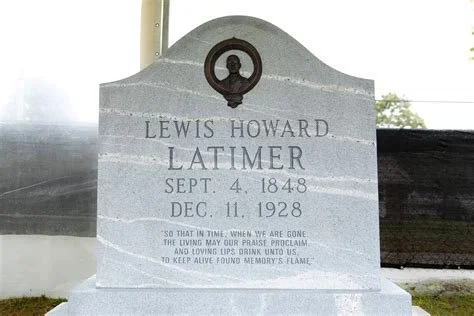
Lewis Howard Latimer is laid to rest at Flushing Cemetery in Queens, New York, a quiet place that now holds one of the great innovators of the electrical age. His resting place stands as a reminder of a legacy that helped bring light to the modern world.