
The Witness Series: Two Circles in the Dark— Ub Iwerks Beside Walt Disney
Two Circles in the Dark brings listeners into the long friendship between Ub Iwerks and Walt Disney through the perspective of Iwerks—the animator, artist, and inventor whose work helped give Mickey Mouse his earliest form and movement. Their partnership began before the famous character, before the studio’s success, and before the Disney name became known around the world. It began in 1919, when two young artists met at the Pesmen-Rubin Commercial Art Studio in Kansas City.
Before they helped transform animation, they were colleagues trying to make a living. After losing their jobs, they briefly established Iwerks-Disney Commercial Artists. Their abilities complemented one another: Walt developed layouts and brought entrepreneurial ambition; Ub supplied precise lettering, inking, and technical skill. Their working relationship continued through the early animation ventures that eventually brought them together in Hollywood, where Ub became essential to the Alice Comedies and Oswald the Lucky Rabbit cartoons.
In 1928, after Walt lost control of Oswald, the partnership helped produce a new character: Mickey Mouse. Walt and Ub developed Mickey together, with Ub playing a central role in shaping the character’s visual design. Ub animated the first Mickey cartoon produced, Plane Crazy, himself in approximately three weeks. Behind the character who would become a worldwide symbol stood an extraordinary amount of individual craft: drawings made one after another, turning an idea into a personality that could move across a screen.
That collaboration gives the episode its emotional center. Monday’s dramatized monologue imagines the space between shared ambition and individual identity: what does it mean to help build something whose public identity becomes inseparable from someone else’s name?
The documented relationship was both productive and strained. Creative disagreements and the opportunity to run his own studio led Ub to leave Disney in 1930, accepting financial backing from distributor Pat Powers. His independent work included the character Flip the Frog and experiments with animation technology.
The separation was not the end of their working story. Ub returned to Disney in 1940, this time concentrating on cameras, visual effects, and technical invention rather than character animation. His later contributions included optical-printing technology for combining live action and animation, and the adaptation of xerography to transfer drawings directly onto animation cels. His return opened a different chapter—one in which his ingenuity helped expand what the studio could put on screen.
This is not only the story of Walt Disney’s ambition or Mickey Mouse’s creation. It is the story of Ub Iwerks: a friend, a collaborator, an independent artist, and an inventor whose contributions extended far beyond the character he helped bring to life. Two Circles in the Dark asks us to look beyond the familiar name—and toward the partnership behind it, where shared invention, separation, and renewed collaboration complicate the myth of the solitary creator.
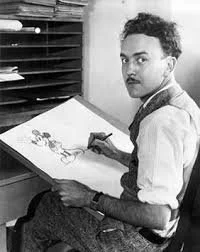
Ub Iwerks Drawing Mickey Mouse, 1930
At the drawing table, Ub Iwerks gives shape to a character the world would come to recognize. His work helped establish Mickey Mouse’s earliest appearance and movement—a reminder that behind a familiar figure stands the craft of an individual artist.
For Two Circles in the Dark, this photograph brings the story back to the work itself: a pencil, a page, and the person whose contribution deserves to be seen.
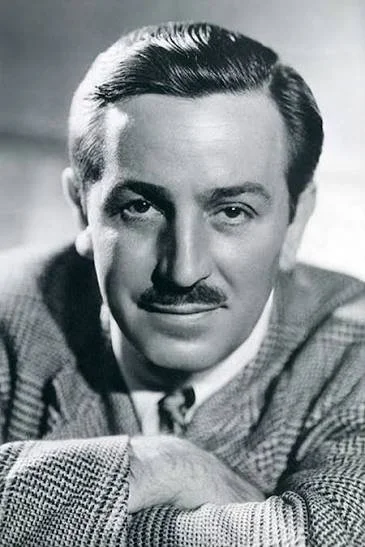
Walt Disney, 1946
By 1946, Walt Disney’s public image stood far from the uncertain beginnings he had shared with Ub Iwerks. This portrait offers a counterpoint to Ub at the drawing table: the familiar face of a creative enterprise whose work depended on many hands.
For Two Circles in the Dark, the photograph invites us to look beyond recognition and back toward the partnership at the heart of the episode—two distinct talents whose shared beginnings became part of a much larger story.