
The Making of a Villain — Part II
The Making of a Villain— Part II: Georges‑Eugène Haussmann — Prefect of the Seine (A Limited Series)
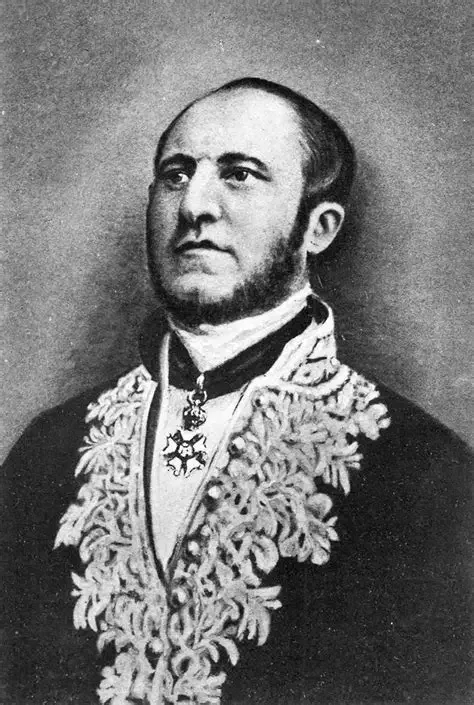
Georges‑Eugène Haussmann (1809–1891)
Prefect of the Seine, Architect of Modern Paris
Georges‑Eugène Haussmann served as Prefect of the Seine from 1853 to 1870, appointed by Napoleon III to carry out one of the most sweeping urban transformations in European history. During his tenure, Paris was reshaped through an ambitious program of boulevards, public parks, sanitation systems, and large‑scale demolition, replacing the dense medieval core with the ordered geometry that defines the city today.
His work produced a capital celebrated for its grandeur and clarity of design, yet it also displaced thousands of residents and erased entire neighborhoods. The legacy he left behind remains a study in contradiction—visionary to some, authoritarian to others, and impossible to separate from the Paris we know now.
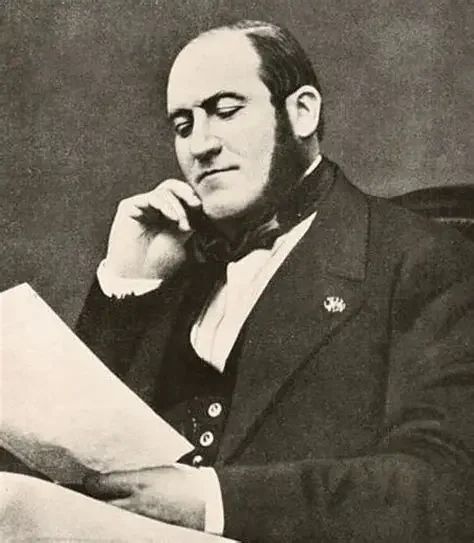
This photograph depicts Haussmann during the period of the Second Empire, reviewing administrative documents related to the urban works underway in Paris. During these years, he supervised the redesign of the city’s street network, the expansion of water and sewage infrastructure, and the creation of major public spaces such as the Bois de Boulogne and Parc des Buttes‑Chaumont. Images of him in civilian dress often show him with maps, plans, or reports tied to the reconstruction program.
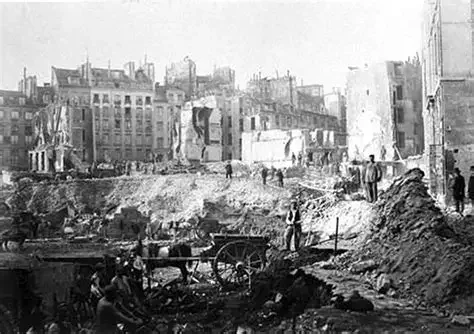
Demolition Work During the Transformation of Paris (1850s–1860s)
This photograph shows a demolition site in Paris during the major urban reconstruction carried out under Georges‑Eugène Haussmann, Prefect of the Seine from 1853 to 1870. Large sections of the old city were cleared to create the new boulevards, sewer systems, and public spaces ordered by Napoleon III. The image captures the early stages of this work: buildings partially dismantled, debris piled in the streets, and laborers using horse‑drawn carts to remove rubble.
Between the 1850s and 1860s, thousands of structures were demolished to open the wide avenues that now define central Paris. These works dramatically altered the city’s medieval street network and displaced many residents, while also modernizing infrastructure and improving circulation.
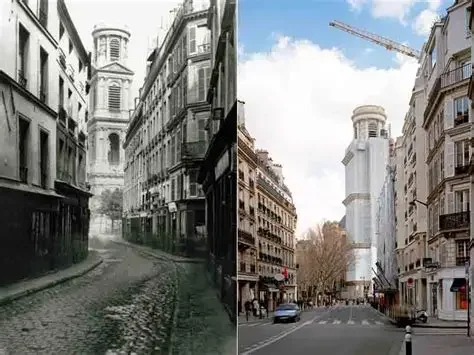
This image presents a side‑by‑side comparison of the same Paris street photographed in two different periods. The older photograph shows the street as it appeared in the 19th century, with its original narrow roadway, historic buildings, and the church tower visible at the far end. The modern photograph shows the same location in the present day, with updated facades, paved roads, parked cars, and ongoing restoration work around the church.
Comparative images like this illustrate how Paris has evolved over time — through preservation, renovation, and modernization — while retaining key architectural landmarks. Although the street itself was not one of the major boulevards created during Haussmann’s reconstruction, it reflects the broader continuity between the city’s historic fabric and its contemporary urban environment.
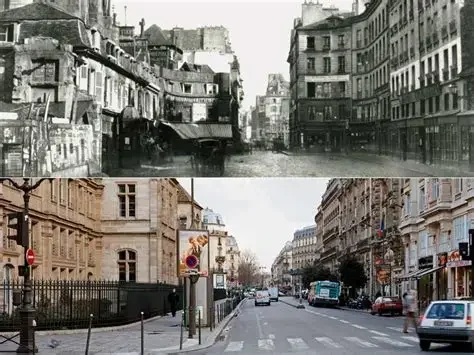
This paired image compares the same Paris street photographed in two different eras. The upper photograph shows the location as it appeared in the late 19th or early 20th century, with narrow roadways, irregular building lines, and the dense architectural fabric typical of pre‑modern Paris. The lower photograph shows the same street in the present day, widened and modernized, with renovated façades, standardized building heights, and updated infrastructure such as sidewalks, signage, and street lighting.
Although not every street in Paris was rebuilt during Haussmann’s tenure, comparisons like this illustrate the broader shift from the older, medieval street network to the more regulated and uniform urban environment that emerged after the Second Empire reconstruction (1853–1870). These changes reflect long‑term patterns of modernization, preservation, and redevelopment that continued well after Haussmann’s dismissal.